Right To Privacy In News Media

News involving minors can always be a touchy subject. Especially when crimes are being committed by minors. School shootings are unfortunately now a fabric of the United States. The phenomena has been at its highest for nearly 25 years now and it doesn’t appear to be going away. On February 4, there was another shooting at a high school in Maryland.(“2 wounded in school shooting in Maryland – CNN.com”)

The question is, during the unravellings of a heinous crime, does the media release the name of the shooter and even more controversially, the potential victims that are minors.

On one hand, in a situation where lives are potentially put at risk, people have a right to now. On the other, these are underage individuals whose identities should arguably be protected. The norm in today’s media is unclear. In a case like Columbine or Sandy Hook, where a live feed is set up and the moments either during or directly after the shooting are being broadcast, identities of suspects are speculated on. Sometimes these speculations are incorrect. A great example of that was during the Sandy Hook coverage, Adam Lanza, the actual shooter, was misnamed. His brother Ryan was named as the shooter in the case. (“Media Mess-Ups: Who’s Who of Sandy Hook School Shooting Reporting Errors, Part 1”)

This was a huge faux pax and created more anguish for the Lanza family than necessary. Adam Lanza was even an adult, 20, at the time of the shooting. If the media can’t make proper identifications with adults, then what makes them equipped to start releasing names of minors that are perpetrators.

It is all up to the discretion of the publication at the end of the day. (“Statement of Journalistic Ethics”)

From the book’s examples, it places even more pressure on the publication. With the four broad frameworks in place to protect privacy, a misstep like the Sandy Hook case coverage would be a direct violation of privacy.

People should know what is around them, but only if the people communicating information to them are responsible enough to do the job right and not violate something like privacy, which is valuable to many people.

Sources

Statement of Journalistic Ethics. (n.d.). Retrieved February 6, 2015, from http://www.dailypress.com/dp-privacy-htmlstory.html

2 wounded in school shooting in Maryland – CNN.com. (n.d.). Retrieved February 6, 2015, from http://www.cnn.com/2015/02/04/us/maryland-high-school-shooting/index.html

Media Mess-Ups: Who’s Who of Sandy Hook School Shooting Reporting Errors, Part 1. (n.d.). Retrieved February 6, 2015, from http://www.imediaethics.org/News/3663/Media_mess-ups__whos_who_of_sandy_hook_school_shooting_reporting_errors__part_1.php

Least Valuable Potter Box Module

The ability to adapt is a cornerstone to any decision making. That being said, definitions, a component of the Potter Box Model of Reasoning and common aspect of life itself are rigid and don’t allow for much adaptation. Definitions are hard to get around because they are so universally accepted. This means that adaptation is limited.

Definitions are meant to be used as a baseline but many people are too caught up in allowing something making the decision for them and uses the definitions as the only aspect to their decision making process. If one decides to make definitions the only part of their decision, it is a shallow decision and mistakes are more likely to be made.

That is why the Potter Box is the way it is. It has four components, and all four components need to be used. Definitions are the least valuable in my opinion and values are the most important, but if the other two components aren’t used in some capacity then mistakes are more likely to happen when the final decision is arrived at.

Potter Box

The “Values” quadrant of the Potter Box method is by far the most important to the process of ethical decision making. In the quadrant, a person or group will look at different values that will influence the final decision. Analyzing and comparing different values are key to this aspect of ethical decision making. It is not the values of the decision makers, but of those who have been affected by a situation that creates an ethical dilemma. Viewing the situation from different perspectives is also key to making the best and most ethical decision. Those perspectives may include aesthetics, logic and morality.

This is the “why” portion of the Potter Box and to me, ethics as a whole is something that people have to decide on, not a certain methodology or process. The “values” portion is putting the decision making directly in the hands of the people that are making said decision.

Everyone has a value system, some have more than others, and those values differ greatly from person to person. That means that everyone can make ethical decisions based on their values, and what they are interpreting as the values in someone else’s situation.

Definitions, and principles are handy in their own regard, but they are also impersonal and not allowing for any change in what one situation may have differences from the initial precedent. In terms of loyalties, that to me is a dangerous area. I’ve always been told not to make big decisions based on my emotions and initial feelings unless absolutely necessary. That is why that portion of the Potter Box does not carry as much weight to me as the values portion does.

The Potter Box allows for all people to make decisions based on what they are comfortable with, and for me, that portion is the values portion. I would not shut out the other portions, but there will always be a premium placed when it comes to values.

Golf has issues too

After reading John Paul’s article in the Wall Street Journal, golf has officially entered the realm of major sports again. The reason why, they have issues within the sport. Not just Tiger Woods and whatever antics he may bring, but issues across the board. Allegations of special treatment and performance enhancing drugs are far too common in most popular sports so this may be a potentially good sign for golf.

Golf has been down and out since the Tiger Woods scandal took off, so the PGA and others, although they should still be battling the issues that they have, should find some solace in the fact that they are like their other major sports counterparts. The only thing holding them back now is Tiger’s slump. If he can break the records everyone thought he could, golf will be near the top again.

School doesn’t teach everything

Many people would say that most knowledge a person gains, comes from whatever schooling they receive. There is a philosophical problem with that statement. There is still a lot of knowledge that school doesn’t and can’t teach you. That is exactly what Brie Dyas points to in her article for the Huffington Post. There are practical things that people need to know that a textbook can’t, like being able to balance a checkbook.

So how does one go out to acquire this knowledge? It is as simple as going out and doing it. It may not be a success the first, but learning comes best, from doing. That is a thing that many schools miss even when they are teaching the basic subjects. People would have a greater understanding of topics if they “did something,”  instead of just reading an outdated textbook.

High school students meet and conduct class in their classroom. Students can learn much more outside the classroom. (Photo via Flickr/RDECOM)

High school students meet and conduct class in their classroom. Students can learn much more outside the classroom. (Photo via Flickr/RDECOM)


Another Hip Hop Artist in Pro Sports……

I love hip hop music. I love the NFL. That does not mean though that I want those two to intertwine. We have already seen one artist, Jay-Z, get involved with ownership of the NBA’s Brooklyn Nets, but the NFL is much different. The NBA is a league that has been run by the hip hop culture for almost three decades now, whereas the NFL has tried to distance itself from anything that would put players in an urban or “thug-like” light. So it is easy to see that there is a conflict of interest here.

Now though, Sean “P Diddy” Combs wants to enter the arean of pro sports ownership. He wants an NFL franchise. I just don’t see this working. With NFL Commissioner Roger Goodell making policies against urban-like clothing in postgame press conferences, how is a hip hop fashion maven like Combs going to be able to promote his brand (SeanJohn) in the league? Because, let’s face it, he’s going to try.

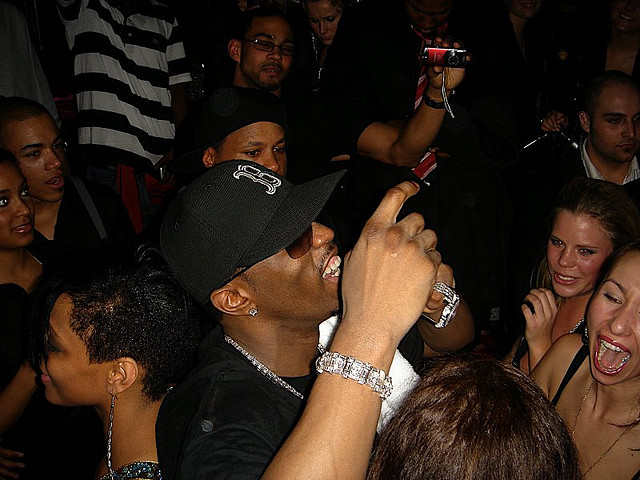
Sean "Diddy" Combs has been in the hip hop industry for two decades. Now he wants to insert himself in the pro sports industry. (Photo via Flickr/Leo Amadeus)

Sean “Diddy” Combs has been in the hip hop industry for two decades. Now he wants to insert himself in the pro sports industry. (Photo via Flickr/Leo Amadeus)